Saturday, July 18, 2009

July 18th

Today is Mandela Day!
Nelson Mandela turned 91 on Saturday and to honor the anti-apartheid activist and Nobel Peace Prize winner, South Africa has renamed the day Nelson Mandela Day. The South African government has called on its citizens to spend 67 minutes of their time on this day in service to the less fortunate and the marginalized.

The number 67 represents the number of years the former South African president has spent fighting for freedom, including 27 years as a political prisoner of the former apartheid regime. Mandela fever has gripped the nation as people visited convalescent homes, prisons, hospitals and clinics to make a difference in the lives of others.
Mandela Day celebrates the idea that each individual has the power to transform the world, the ability to make an imprint. Looking back, we've got a whole lot of work ahead of us.

The Great Fire of Rome According to the historian Tacitus, Magnum Incendium Romae started on the night of 18 July in the year 64 AD. It began in the shops clustered around the Circus Maximus and spread rapidly through the mostly wooden homes of the city. Even though popular legend remembers Nero playing the fiddle while Rome burned, Tacitus said that Nero playing his lyre and singing while the city burned was only a rumor. Apparently Nero was out of town and the fiddle would not be invented for another thousand years.
According to Tacitus, upon hearing news of the fire, Nero rushed back to Rome to organize a relief effort, which he paid for from his own funds. After the fire, Nero opened his palaces to provide shelter for the homeless, and arranged for food supplies to be delivered in order to prevent starvation among the survivors. In the wake of the fire, he made a new urban development plan. Houses after the fire were spaced out, built in brick, and faced by porticos on wide roads.
But many in the local population blamed Nero and his reconstruction plans were unpopular. While Nero didn't have to worry about reelection, he probably was thinking of what happened when Gaius Julius Caesar became unpopular. So being a typical politician, Nero found a scapegoat. To diffuse blame, Nero targeted the Christians. Confessions were coerced with methods far more crude than the modern day Guantanamo Bay interview and Tacitus described the persecution.
Accordingly, an arrest was first made of all who pleaded guilty; then, upon their information, an immense multitude was convicted, not so much of the crime of firing the city, as of hatred against mankind. Mockery of every sort was added to their deaths. Covered with the skins of beasts, they were torn by dogs and perished, or were nailed to crosses, or were doomed to the flames and burnt, to serve as a nightly illumination, when daylight had expired.


On July 18, 1290 King Edward I of England issues the Edict of Expulsion, expelling all Jews from England. Lasting for the rest of the Middle Ages, it would be over 350 years until it was formally overturned in 1656.

On July 18, 1536 the Christians were no longer persecuted by the Romans but the Holy Roman Empire had a problem of a different sort. The authority of the Pope was declared void in England by an act of Parliament. Apparently it was a marital issue.

In 1627, French explorers noticed oil seeping out of the ground in western New York. It was the first recorded mention of oil on the North American Continent. The Seneca Oil Spring is located near the spillway end of Cuba Lake on the Oil Spring Indian Reservation.

On July 18, 1716, a decree orders all Jews expelled from Brussels.

In 1792, American naval hero John Paul Jones died in Paris at age 45. On September 23, 1779, Jones achieved his most famous victory off the coast of England. While engaging the British merchant fleet led by the Serapis in heavy combat for over three-and-one-half hours, his flagship the Bonhomme Richard, which he had renamed in honor of his patron Benjamin Franklin was sinking. After heavy losses of life on both sides, the British surrendered allowing Jones and his crew to abandon their sinking ship and transfer to the captured Serapis. As the American ship was listing, Jones’s answered the enemy's demand that he surrender with the immortal words, "I have not yet begun to fight!"

The more things change, the more they stay the same. On this day in 1876 the British government agreed to a Royal Commission on Noxious Vapours that would determine the effects of certain gases and vapors emitted by industry and investigate means of prevention. They Wrinkle Their Noses. The report two years later would bring better regulation but warn of impeding economic growth.
But witnesses who argued that noxious vapors were inevitable if the nation was to prosper had their effect. The commission noted that regulation was only practical if it did not involve "ruinous expenditure." And courts remained reluctant to shut down polluters if the result would destroy the industry of a town.

London suffered a killer smog in December 1952 that killed as many as 12,000 people. Britain passed its Clean Air Act in 1956. The United States passed a weak Clean Air Act in 1963 and strengthened it in 1970.

Actually America's first attempt at pollution control came in 1955, seven years after The Donora Smog Disaster.

Today was the first day of the Second Battle of the Isonzo in 1915. It was fought between the armies of the Kingdom of Italy and of Austria-Hungary on the Italian Front in First World War. By the end of that battle on August 15th, the total casualties were about 91,000 men, of which 43,000 Italians and 48,000 Austro-Hungarians. 280,000 Italians lost their lives during the four battles waged over Isonzo River in 1915. "In the course of 1916 the Italians had sustained 500,000 casualties."

Three years later, on the birth date of Nelson Mandela, it was the third day of the Second Battle of the Marne. American and French forces launched a successful counteroffensive against the Germans. This battle that marked the turning of the tide in World War I was the last German offensive and was quickly followed by the first allied offensive victory of 1918. The American Expeditionary Force with over 250,000 men fighting under overall French command played key roles both in the initial defense and the later advances. On July 18th "the American troops in a magnificent counterattack threw a whole division of Germans back across the Marne River." In succeeding to drive the Germans back and capturing 1000 German prisoners 30,000 Americans were killed or wounded.

In 1925, a preview of evil rearing it ugly head once again. On July 18, 1925 Adolf Hitler published his book "Mein Kampf," calling for a national revival and a battle against the Communism and Jews. Only 15 years after 15 million people were killed in World War I, Hitler became the leader of Germany and began fulfilling his dream to "overthrow the shackles of the Treaty of Versailles."

On this day in 1940, Franklin Delano Roosevelt, the greatest American who ever lived, was nominated for an unprecedented third term. The man who created the middle class first took office in 1933 as America's 32nd president. Roosevelt would eventually be elected to a record four terms in office, the only U.S. president to serve more than two terms. In order to prevent a hero of the people ever offering so much hope and prosperity to the working class again, two years after the death of the great man, Congress passed the 22nd Amendment to the U.S. Constitution. The amendment that prevents a third term for American presidents was ratified by the required number of states in 1951.

In 1964, The 4 Seasons fourth song to reach the #1 spot was "Rag Doll." The Jersey Boys other #1 hits were: "Big Girls Don’t Cry," "Walk Like a Man," and "December, 1963 (Oh, What a Night)."

On this day, the process started going micro. Integrated Electronics Corporation (Intel) was founded on July 18, 1968. Originating as a Maker of semiconductors, in 1971 Intel released its first microprocessor, the 4004 designed for a calculator. In 1972 came the more powerful 8008. With the introduction of the 8080 in 1974, the first personal computers were made possible.

On July 18, 1974, because of a marijuana possession charge, in another country no less, the so called Justice Department of the United States denies John Lennon an extension of his non-immigrant visa and orders him out of the country by September 10.

On this day in 2003, the body of Dr David Kelly was found in the woods not far from his Oxfordshire home. At the time of his death there was much controversy in his life and Dr Kelly has been at the center of a row between the British Government an reality.
The row centred on a report by journalist Andrew Gilligan during the Today programme on BBC Radio Four in which he said the government had "sexed-up" its dossier on Iraq to boost public support for the war.

He accused the government of inserting a claim into the dossier that Saddam Hussein was capable of deploying weapons of mass destruction within 45 minutes.

Dr. Kelly's body was discovered just days after appeared before the Parliamentary committee charged with investigating the scandal and many questions remain unanswered about David Kelly's suspicious death.

Five years ago today: A spokesman said California Gov. Arnold Schwarzenegger would not apologize for mocking certain lawmakers as "girlie men," despite criticisms from Democrats that the remark was sexist and homophobic.

One Year ago today: "The Dark Knight," starring Christian Bale as the caped crusader and Heath Ledger as the Joker, premiered.

Friday, July 17, 2009

July 17th

On this day in 1794 the rebels had their biggest victory in the Whiskey Rebellion. Back in 1791 things were getting off to a flying start in the federal government. To raise cash for the new government, Alexander Hamilton convinced Congress to approve taxes on alcohol and carriages. (No not baby carriages) In what would become an American tradition, Congress designed the tax so smaller distillers would pay more than larger distillers. George Washington was a big time booze maker and he got to pay 6 cents per gallon, while the little guy was taxed at 9 cents per gallon.
Hamilton's principal reason for the tax was that he wanted to pay down the national debt, but he justified the tax "more as a measure of social discipline than as a source of revenue." But most importantly, Hamilton "wanted the tax imposed to advance and secure the power of the new federal government."
In the new nation that was without a caste system, the "cohee" of the frontier, which was like Pennsylvania back then, were having none of this. Considered it to be both unfair and discriminatory, civil protest soon became an an armed rebellion. In the summer of 1794, what with no dead presidents masks available yet, some rebels disguised themselves as women to tar and feathers a tax collector. On July 17, the rebels had their biggest victory. 500 armed men clashes with troops from Fort Pitt after firing on a revenue collector and burning down his home.
Get you a copper kettle, get you a copper coil,
Fill it with new-made corn mash and never more you'll toil.
You'll just lay there by the juniper while the moon is bright,
Watch them jugs a-filling, in the pale moonlight.

Build you a fire with hickory, hickory, ash and oak,
Don't use no green or rotten wood; they'll get you by the smoke.
We'll just lay there by the juniper while the moon is bright,
Watch them jugs a-filling, in the pale moonlight.

My daddy, he made whiskey; my granddaddy, he did too.
We ain't paid no whiskey tax since 1792.
We just lay there by the juniper while the moon is bright,
Watch them jugs a-filling, in the pale moonlight.
Within the next three weeks, 15,000 uniformed militiamen enter into the fray and the "Whiskey Rebellion" was no more. Big business won, the "cohee" chalked one up in the loss column.

In 1821, warm beaches and a retirement heaven. When the Adams-Onís treaty was concluded with Spain, the Spanish ceded Florida to the United States and war with Spain was delayed for 77 years. But 180 years later it didn't seem like such a good idea.

In 1861, Congress authorized the Treasury Department to print and circulate paper money for the first time. Not immediately called the "Federal Reserve Notes," Congress was pressed for money to finance the Civil War so they authorized "Demand Notes" and replaced that a year later with "Legal Tender Notes". These were the predecessors of the "Greenbacks" today that are not worth the paper they are printed on.

In 1862, Congress authorizes African Americans to become laborers in the U.S. Army. Over 186,000 African-Americans serve in the Union Army, with 38,000 losing their lives.

In 1898, Spanish troops in Santiago, Cuba, surrendered to U.S. forces during the Spanish-American War. Two and a half years later, at the signing of the Cuban-American Treaty, The United States took permanent possession of Guantanamo Bay.

On July 17, 1899, James Cagney, the Academy-Award winning American film actor, was born. Following his death on March 30, 1986, his obituary appeared in The New York Times.

In 1901, Dr. Willis Carrier installed a commercial air conditioning system at a Brooklyn, NY printing plant. The first system to provide man-made control over temperature was not meant for humans but machines. In 1902, Carrier completed drawings for what came to be recognized as the world's first scientific air conditioning system. By the early 1920s the centrifugal chiller by Carrier led to comfort cooling appearing in movie theaters for summer blockbusters. Then came department stores and office buildings. Now chillin' out in July is considered a must.

On July 17, 1917 with Great Britain at war with Germany, King George V issues a royal proclamation, changing name of the British royal from the German Saxe-Coburg Gotha to Windsor. Everyone is immediately fooled into believing that a bunch of inbred Germans are really English.

Today in American Memory section of The Library of Congress, homage is payed to the Spanish Civil War.
The Spanish Civil War began on July 17, 1936 as a series of right-wing insurrections within the military, staged against the constitutional government of the five-year-old Second Spanish Republic. Because it was the first major military contest between left-wing forces and fascists, and attracted international involvement on both sides, the Spanish Civil War has sometimes been called the first chapter of World War II.

The rebels, or Nationalists as they came to be known, were backed by a spectrum of political and social conservatives including the Catholic Church, the fascist Falange Party, and those who wished to restore the Spanish monarchy. They received aid in the form of troops, tanks, and planes from Fascist Italy and Nazi Germany, and Germany field-tested some of its most important artillery in Spain. With the rise of General Francisco Franco as leader of the Nationalist coalition, the threat of fascism's spread across Europe visibly deepened.

The Republicans were backed by Spanish labor unions and a range of anti-fascist political groups, from communists and anarchists to Catalonian separatists to centrist supporters of liberal democracy. The Republicans received aid from the Soviet Union and from Mexico, but their most likely European allies signed a joint agreement of nonintervention. The most visible international aid came in the form of volunteers. Estimates vary, but as many as 60,000 individuals from over fifty countries joined the International Brigades to fight for the cause of the Spanish Republic. Between two and three thousand of these volunteers were men and women from the United States—most served with the Abraham Lincoln Brigade.

The Spanish Civil War posed a major threat to international political equilibrium, and Americans watched closely the events of the conflict. The brutality of the situation also forced many Americans to question the United States' post-World War I noninterventionist policies. Between 500,000 and 1 million Spaniards, both soldiers and civilians, died from war or war-engendered disease and starvation, and thousands more became displaced refugees.
‘Wrong Way’ Corrigan wasn't so wrong after all. Americans may be bad at geography but on July 17, 1938 when he left Floyd Bennett Field in New York, supposedly headed for Los Angeles,how long could he say to himself "Wow that Hudson River is bigger than I thought." A 3,150-mile wide river! According to Wikipedia, Douglas Corrigan knew what he was doing.
Corrigan, however, was a skilled aircraft mechanic (he was one of the builders of Charles Lindbergh's Spirit of St. Louis) and a habitual risk-taking maverick; he had made several modifications to his own plane, preparing it for transatlantic flight. Between 1935 and 1937, he applied several times, unsuccessfully, for permission to make a nonstop flight from New York to Ireland, and it is likely that his "navigational error" was a protest against government "red tape"; however, he never publicly acknowledged having flown to Ireland intentionally.
The man who is remembered every time a football player goes the wrong way was welcomed home as a hero (ticker tape parade and all) and was forever known as ‘Wrong Way’ Corrigan.

On July 17, 1944, munitions, which were being loaded aboard the SS E.A. Bryan at the Port Chicago Naval Magazine north of Oakland, California, detonated, killing 320 sailors and civilians and injuring 390 others. Most of the dead and injured were enlisted African-American sailors.

On this day in 1948, The Dixiecrat Revolt and Strom Thurmond.
Tensions came to a head in 1948 when, in an unprecedented move, President Harry Truman placed himself squarely behind civil rights legislation. Truman advocated federal protection against lynching, anti-poll tax legislation, the establishment of the permanent Fair Employment Practices Commission (FEPC), and the prohibition of segregation in interstate transportation. For the first time since Reconstruction, the status of African Americans had become a national issue. Many white southerners believed these measures signaled the beginning of an insidious campaign to destroy cherished regional "customs and institutions."
On July 16, 1948 Southern Democrats opposed to the Democratic party's position on civil rights met in Birmingham, Ala., to endorse South Carolina Gov. Strom Thurmond.

In 1954, the world’s first jazz fest. The tennis courts of Newport Casino, in Newport, Rhode Island, were host to the first Newport Jazz Festival. The opening song was performed by Eddie Condon and his band who played "Muskrat Ramble."

In 1955, Walt Disney opened the gates to "The Happiest Place on Earth." The man who claimed "That place is my baby, and I would prostitute myself for it," held a gala television broadcast featuring Bob Cummings, Art Linkletter and Ronald Reagan on the opening day of Disneyland.

On the same day in 1955, Arco, Idaho became became the first community in the world to have all its electrical needs provided by nuclear power. The one hour demonstration was made to show the safety of nuclear-powered electricity and its ability to sustain the load.

In 1959, Mary Leakey, the wife of Dr Louis Leakey, made a very significant find when she discovered an ancient hominid skull, the first specimen of a formerly unknown species. Found in the Olduvai Gorge in northern Tanzania, Louis Leakey briefly considered this to be a human ancestor, but the claim was dropped when Homo habilis was found soon afterward. Originally named "Zinjanthropus" (East African Man), the skull was later renamed "Australopithecus boisei". The Leakey's dedicated their lives to the study of Australopithecus and estimated that the skull's age was 1.75 million years old.

On July 17, 1959 "Lady Day" no longer sings the Blues. Billie Holiday, known to her fans as "Lady Day," died in a New York City hospital at age 44."Sometimes it's worse to win a fight than to lose." — Billie Holiday

On July 17, 1961 "The Georgia Peach," Ty Cobb died at the age of 74 from cancer. Considered to be one of or perhaps the greatest baseball player in history, he still holds several records as of 2009, including the highest career batting average (.367)

On July 17,1967 Jimi Hendricks ended his short career as a warm act for the Monkees.
To make a bad situation even worse, Hendrix joined the tour in progress in Jacksonville, Florida on 8 July 1967, just before the Monkees were scheduled to play a couple of shows in North Carolina. One would have been hard pressed to have found a part of America less likely to appreciate what Micky Dolenz described as "this Black guy in a psychedelic Day-Glo blouse, playing music from hell, holding his guitar like he was fucking it, then lighting it on fire" and what Eric Lefcowitz termed "the cacophonic strains of Hendrix's feedback orgies mixed with his lascivious sexuality."

Matters came to head a few days later as the Monkees played a trio of dates in New York. After a handful of gigs, Hendrix grew sick of the "We want the Monkees" chant that met his every performance. Finally, he flipped the bird at the less-than enthusiastic crowd at Forest Hills Stadium in New York and stormed offstage.
On July 17, 1975, the last of the Apollo spaceship program docked with a Soyuz spacecraft in orbit. The first superpower linkup of its kind, seemed sort of sexual.

In 1979, Jimmy Carter was having none of Nicaraguan President Anastasio Somoza's Miami retirement plans as the Sandinista rebels take Nicaraguan capital.

In 1981, 114 people died in the lobby of the Kansas City Hyatt Regency Hotel. A pair of walkways above the lobby collapsed during a dance.

In 1985, Bank of America, the United States second largest banking company, reported a second-quarter loss of $338 million. Maybe the government should have fixed that.

In 1986, the largest filing for bankruptcy in the history of the United States occurred when the LTV Corporation asked for court protection from debts of more than $4 billion. $3 billion of it was retiree benefits that LTV just cutoff . This act led to the Retiree Benefit Bankruptcy Protection act of 1988 that did little to protect retiree's pension and nothing to protect their healthcare. Later during the Shrub era when Congress passed a bill to protect corporations from individuals, corporations were still free to pull the same crap and get this, LTV Corporation screwed the workers again. And if that's not enough for you, in this good old shadow welfare state we live in, LTV is still in business.

In 1996, 230 people died aboard TWA Flight 800. Shortly after leaving John F. Kennedy International Airport, the Boeing 747 bound for Paris, exploded and crashed off Long Island, N.Y.

In 1997, the last day of the Five and Dime. Woolworth Corp. closed its last 400 stores and laid off 9,200 employees.

On this day in 1998, Russia buries Tsar Nicholas II and family, 80 years after they died. Russia's Nicholas II, his wife, their five children, their doctor, cook, valet, maid and even the family dog were executed by the Bolsheviks. They must have been afraid that someday the dog would seek revenge or reclaim the throne. The youngest human to die was the thirteen year old son of Nicholas and Alexandra, Alexei Nikolaevich.

Five years ago today: Arnold Schwarzenegger used the term "girlie men" to describe California Democrats and called upon voters to "terminate" them at the polls in November if they don't pass his $103 billion budget.

One year ago today: With signs that the record salmonella outbreak, while not over, may finally be slowing, the FDA lifted its warning on tomatoes. Hot peppers were still a no no. And if that leaves a bad taste in your mouth, George W. Bush and Iraqi Prime Minister Nouri al-Maliki held a secure video conference during which they agreed to set a "general time horizon" for bringing more U.S. troops home from the Iraq war.

Thursday, July 16, 2009

July 16th

Not the Bull but the Edict of 1054. On this day, after negotiations broke down between Humbert of Mourmoutiers and with Constantinople on differences between the Christian East and Rome, Old Humbert got a little carried away.
"So finally with his patience exhausted, Humbert and his colleagues strode into the Church of Santa Sophia on Saturday, July 16, 1054, right before the chanting of the afternoon liturgy and laid on the altar a bull excommunicating Cerularius, Emperor Michael Constantine, and all their followers, and then departed, ceremonially shaking the dust off their feet."
Thus began the 'Great Schism' between the Western and Eastern churches. It only took 911 years until Pope Paul VI and Patriarch Athenagoras buried the hatchet but things will never be the same.

It may not be as bad as it sounds. On this day in BrainyHistory there is an entry for July 16, 1099 "Crusaders herd Jews of Jerusalem into a synagogue and set it afire." But according to Wikipedia's History of the Jews and the Crusades during the Massacre of Jerusalem the synagogue may have been empty when the Crusaders torched it for shits and giggles.

From The List of The Banned, on July 16, 1439, kissing is banned in England. They did have a better reason than the usual crap.

The Connecticut Compromise was forged on July 16, 1787. Presented by Roger Sherman and Oliver Ellsworth of the Connecticut delegation, a dual system of congressional representation was a victory for the smaller states. There would be an "Upper House" with two representatives from each state chosen by state legislators. The "Lower House" members would serve two year terms and be elected by the people based on population. A census would be taken every ten years and although women would not be allowed to vote they would be counted. African Americans didn't do as well. They could not vote and each would be counted as three fifths of a person.

When George Washington signed the Residence Act of July 16, 1790 an area called the District of Columbia on the banks of the Potomac River was turned into a swamp.
On Dec. 1, 1800, the capital was moved to the newly named city of Washington. The 1800 census counted 14,103 residents of the U.S. capital, composed of 10,066 whites, 793 free black people and 3,244 slaves.
On this day in 1911 Ginger Rogers "who did everything Fred Astaire did, except backwards and in high heels" was born.
The blond, blue-eyed actress, who came out of Charleston contests and the vaudeville circuits to win notice as a cherub-faced flapper with a piping voice and a sassy air in early musicals like "42d Street" and "Gold Diggers of 1933," went on to win acclaim for her dramatic portrayals and an Academy Award for best actress for her depiction of a lovelorn career woman in the 1940 film "Kitty Foyle."
On July 16, 1918, Russia's Czar Nicholas II, his wife, their five children, their doctor, cook, valet, maid and even the family dog were executed by the Bolsheviks. I guess they were afraid that someday the dog would seek revenge or reclaim the throne.The youngest human to die was the thirteen year old son of Nicholas and Alexandra, Alexei Nikolaevich.

On July 16,1927 "a respected spokesman for right-wing extremism and religious prejudice" and the only American mentioned by his admirer Adolph Hitler in Mein Kampf, that respected captain of industry, Henry Ford, settles a $1 million libel suit brought by labor organizer Aaron Sapiro. Ford's newsweekly, The Dearborn Independent, had accused Sapiro of being part of a conspiracy of "Jewish bankers" to seize control of national wheat production and hand it over to the Communists.

On this day in 1945 British Prime Minister Winston Churchill, US President Harry S Truman and leader of the Soviet Union Josef Stalin gather at Potsdam to discuss the rebuilding of Europe.

Truman must have hustled home because on that same day in 1945 "Fat Boy" went off at Alamogordo Air Base. All life within a mile radius was killed or obliterated as the fireball rose 8,000 feet in a fraction of a second and mushroom-shaped cloud made 41,000 feet above the New Mexico desert. Three weeks later the atomic bomb was used for its intended purpose, twice!

Did you know that ZIP stands for Zone Improvement Plan? There are 43,000 5-digit zip codes. On this day in 1963 the U.S. Postal Service began using ZIP codes.

July 16,1973 was a good day for truth. While the Senate Armed Services Committee began probes into allegations that the US Air Force had made 3,500 secret B-52 raids into Cambodia in 1969 & 1970, at the Senate Watergate hearings, former White House aide Alexander P. Butterfield publicly revealed the existence of President Richard Nixon's secret taping system. Tricky Dicky must have been buggin' out.

One Great day in 1967! Surprisingly far from Thanksgiving, the son of Woody "This Land Is Your Land" Guthrie, twenty year old Arlo, attended the Newport Folk Festival and found himself promoted to the closing-night concert on the main stage, performing "Alice's Restaurant Massacree" to 20,000 folk fans on July 16, 1967.
They got a building down New York City, it's called Whitehall Street,
where you walk in, you get injected, inspected, detected, infected,
neglected and selected. I went down to get my physical examination one
day, and I walked in, I sat down, got good and drunk the night before, so
I looked and felt my best when I went in that morning. `Cause I wanted to
look like the all-American kid from New York City, man I wanted, I wanted
to feel like the all-, I wanted to be the all American kid from New York,
and I walked in, sat down, I was hung down, brung down, hung up, and all
kinds o' mean nasty ugly things. And I waked in and sat down and they gave
me a piece of paper, said, "Kid, see the phsychiatrist, room 604."

And I went up there, I said, "Shrink, I want to kill. I mean, I wanna, I
wanna kill. Kill. I wanna, I wanna see, I wanna see blood and gore and
guts and veins in my teeth. Eat dead burnt bodies. I mean kill, Kill,
KILL, KILL." And I started jumpin up and down yelling, "KILL, KILL," and
he started jumpin up and down with me and we was both jumping up and down
yelling, "KILL, KILL." And the sargent came over, pinned a medal on me,
sent me down the hall, said, "You're our boy.
For many the song and famous lyrics have become a Thanksgiving tradition.

In 1969, We have Ignition. An estimated one million live viewers and almost everyone with a television watched as Apollo 11 took off for the first manned exploration of the moon.
Watch it again here!

July 16,1980 was a very bad day for truth. Ronald Reagan won the Republican presidential nomination at the party's convention in Detroit.

July 16,1981 was a dark day in music. At the age of 38, folk-rock balladeer 38 year old Harry Chapin died in a car crash in New York. Besides being an organizer for efforts to provide food to the needy, a champion for the hungry and homeless, Chapin's was some of the finest ballads of his day. Taxi, W-O-L-D and Cat’s in the Cradle.

Ten years ago today: Such a sad day. John F. Kennedy, Jr., his wife Carolyn, and sister-in-law Lauren die in a plane crash in the Atlantic Ocean off the coast of Martha's Vineyard. The Piper Saratoga aircraft was piloted by Kennedy.

Five years ago today: What does all the other rich have that Martha Stewart didn't? On this day she was sentenced to five months in prison and five months of home confinement by a federal judge in New York for lying about a stock sale.
"Yes! We finally captured Martha Stewart. You know, with all the massive and almost completely unpunished fraud perpetrated on the public by companies like Enron, Global Crossing, and Tyco we finally got the ring leader. Maybe now we can lower the nation's terror alert to periwinkle."—Jon Stewart
Two years ago today: The World Court ordered the Bush administration to halt the execution of five Mexican nationals sentenced on death row in the United States. Apparently Bush was not impressed.

One year ago today: Bush Invokes Exec Privilege to Block CIA Leak Testimony. And the Hits just keep on coming.

Wednesday, July 15, 2009

July 15th

On this day in 1099, Jerusalem was captured by the First Crusade. In the traditional Christian manner, 10,000 were massacred and the Crusaders plundered everything they could get their hands on.

July 15, 1205 was another of those great moments in Vatican History. In the words of the infallible Pope Innocent III, the Jews "shall not dare raise their neck, bowed under the yoke of perpetual slavery." The Pope declares that the Jews are consigned to continual subjugation just for crucifying our Lord and Savior.

On this day in 1606 one of the greatest painters and print makers in European art history and the most important in Dutch history, Rembrandt Harmenszoon van Rijn was born in Leiden, Netherlands.

In 1863 after three days of death the New York anti-draft riots ends. Over 1,000 died in the riots, including many free blacks attacked & murdered by Confederate sympathizers.

July 15, 1869 "I Can't Believe It's Not Butter" Well they didn't win the war but they had a better spread. On this day in tactical history after French ruler Napoleon III commissioned Hippolye Mege Mouries to find a butter substitute for the war with Prussia, a patent for a beef based buttery spread is issued. Probably because the taste was marginal it was called margarine. Well actually it was because Hippolye Mege Mouries "had used the fatty acid component, margaric acid."

In 1870, Georgia became the last Confederate state readmitted to the Union while Manitoba entered confederation as the fifth Canadian province.

In 1908, at age eighteen, Jean Cocteau publishes his first poem, "Les Façades."
"The instinct of nearly all societies is to lock up anybody who is truly free. First, society begins by trying to beat you up. If this fails, they try to poison you. If this fails too, they finish by loading honors on your head."
— Jean Cocteau (1889-1963)
On July 15, 1918, the Second Battle of the Marne began during World War I.
The Second Battle of the Marne marked the turning of the tide in World War I. It began with the last German offensive of the conflict and was quickly followed by the first allied offensive victory of 1918. The American Expeditionary Force with over 250,000 men fighting under overall French command played key roles both in the initial defense and the later advances. In the Second Battle of Marne with 30,000 killed and wounded, the United States started suffering casualties on the enormous scale usually associated with the battles of the Great War.
According to the New York Times article "the American troops in a magnificent counterattack threw a whole division of Germans back across the Marne River."

On July 15, 1922, for the first time in the United States, the Bronx Zoo displayed a duck-billed
platypus
.

In the Summer of 42, The Glen Miller Orchestra recorded "Juke Box Saturday Night" and on the same day the movie The Pride of the Yankees opened in new York starring Gary Cooper and Babe Ruth. Those Were the Days.

A Great Day for Democratic Hopefuls. On this day in 1948 President Harry S. Truman was nominated for another term by the Democratic National Convention in Philadelphia. Twenty-six years later Jimmy Carter delivered his great acceptance speech for the Democratic nomination at Madison Square Garden. Forty-four years later, Bill Clinton claimed the Democratic presidential nomination at the party's convention, also in New York City. There was another good nomination for Democrats on this day, on July 15, 1964 Barry Goldwater was nominated for president at the Republican National Convention in San Francisco. San Francisco?

In 1965, the Mariner IV spacecraft sent back the first close-up pictures of the planet Mars.

"One Life to Live." On this day in 1968 Llanview, Pennsylvania was born. The creation by Agnes Nixon would lead to an ABC dominance in daytime dramas. The first few years of the show were rich in issue stories and characters including Jewish characters, Polish-American families, and the first African-American leads, Carla Gray (Ellen Holly), and Ed Hall (Al Freeman, Jr.).

On July 15, 1971, President Richard Nixon startled the country by announcing he would visit the People's Republic of China. Back then our government portrayed an evil empire of communists but Nixon was going to to seek a "normalization of relations." Not so shocking now that they have become a "one party nation" that when they say "Jump," America owing so much money to China asks "How High?"

In 1973, Let's Not Drink to the Death of a Clown. On that day the very Kinky Ray Davies, announces retirement from Kinks and his wife's decision to leave him, then attempted suicide.
My makeup is dry and is cracked on my chin
I'm drowning my sorrows in whisky and gin
The lion tamer's whip doesn't crack anymore
The lions they won't fight and the tigers won't roar
What a crying shame that would have been. Ray is still going strong. Keep on Rockin' Dave.

In 1974 there was a televised suicide. During a live broadcast of the Sarasota, Florida morning news program Suncoast Digest, newscaster Chris Chubbuck last words before shooting herself in the head was "In keeping with Channel 40's policy of bringing you the latest in blood and guts, and in living color, you are going to see another first: an attempted suicide."

On this day in 1975, the first international manned spaceflight. The Russian Soyuz and the U.S. Apollo launched. The Apollo-Soyuz mission was also the last mission in the Apollo program.

Five years after the televised suicide, Reality TV. America was not ready for reality but on this day in 1979 President Jimmy Carter went on television to bring up an American "Crisis of Confidence." In a call for energy independence, protecting the environment and helping the Americans that need help most, President Carter showed way too much confidence in the elected officials and his own Party. While he never used the word, what should have been the most important speech of the late 20th century, became known as the "malaise" speech.

In 1987 Plausible deniability was stretched to the extreme as John Poindexter took the stand and took the rap at the Iran-Contra hearings.

In 1995, Serbs forced Muslims out of Srebrenica. Some 40,000 women, children and elderly people were ordered to leave the "safe area" of Srebrenica by the Bosnian Serbs. Reported by the BBC "United Nations officials say it is the biggest "ethnic cleansing" operation since World War II."

In 1996 MSNBC, a 24-hour all-news network, made its debut on cable TV and the Internet. Now Rupert Murdoch has one of those too.

In 1999, on the day that China declared they had invented their own neutron bomb, the U.S. government acknowledged for the first time that thousands of workers were made sick while making nuclear weapons and announced a plan to compensate some of them.

In 2007, the Philadelphia Phillies lost their 10,000th game, 10-2, to the visiting St. Louis Cardinals. On the same day, the Roman Catholic archdiocese of Los Angeles announced it was settling clergy sex-abuse cases for $660 million.

Tuesday, July 14, 2009

July 14th

"Le Jour de la Bastille" is celebrated as the dawn of democracy in France. On this day in 1789 citizens of Paris (more like a mob of 20,000) stormed the Bastille prison and released the seven prisoners inside. The prison was a symbol for absolutism of the monarchy of Louis XVI. The prisoners were four forgers, an accomplice to murder, a nobleman jailed for incest, and an insane Irishman. The prison guards had a very bad day and the warden's head ended up on a pike but in about a year Louis XVI lost more than just his crown.

On July 14, 1798 the Constitution of the United States was under seige. Yea so what else is new? Because John Adams had a very thin skin and supporters of Thomas Jefferson were calling him names like "bald," "blind," "crippled," and "toothless," on this day in American history Congress passed a law making it a federal crime to publish false, scandalous or malicious writing about the U.S. government.
To announce that there must be no criticism of the president, or that we are to stand by the president right or wrong, is not only unpatriotic and servile, but is morally treasonable to the American public. — Theodore Roosevelt
The Sedition Act was actually the last of four passed on that dark year. One act—the Alien Enemies Act—is still in force in 2009, and has frequently been enforced in wartime. Thomas Jefferson held them all to be unconstitutional, pardoned and ordered the release of all who had been convicted because of The Sedition Act. Where is Thomas Jefferson when we need him?

On July 14, 1834 James McNeill Whistler, the famed American-born painter and designer, was born. Following his death on July 17, 1903, his obituary appeared in The New York Times. (Go to obit.)

Today is also an historic day for Glass Houses. On July 14th in 1853 America's first World's Fair began in the Crystal Palace, a huge iron and glass structure on the site of today's Bryant Park in New York City.

In 1867, Alfred Nobel (of Peace Prize fame) first showed off his explosive invention. Dynamite was demonstrated at Merstham Quarry in Redhill, Surrey.

In 1868, Alvin J. Fellows of New Haven, CT patented the tape measure. Alvin’s measurements: 40-46-42.

July 14, 1868 was also the day that Gertrude Bell was born. Gertrude Bell had the nickname "Uncrowned Queen of Iraq." Her knowledge of the Middle East earned her an appointment to the British intelligence services during World War I. She was largely responsible for the selection of Faisal I as king of Iraq and the proposed borders within Mesopotamia to include the three Ottoman Empire vilayets that later became Iraq. Bell's influence led to the creation of a country dominated by an oil rich Shi'ite majority in the south and denied the Sunni Kurds a separate, autonomous area or state. The British attempt to control the potential oil fields has been causing trouble ever since.

In 1912, a hero of the people was born. Woody Guthrie who wrote "This Land Is Your Land," "Bound for Glory," "Union Maid" and other American classics, crisscrossed the nation, living & singing among the dispossessed.
A folk song is what’s wrong and how to fix it or it could be
who’s hungry and where their mouth is or
who’s out of work and where the job is or
who’s broke and where the money is or
who’s carrying a gun and where the peace is.

– Woody Guthrie
His music and lyrics helped remind Americans of government actions like The Ludlow Massacre.

In 1916 the Dada Manifesto by Hugo Ball was read for the first time.
How does one achieve eternal bliss? By saying dada. How does one become famous? By saying dada.
Well it worked for a while for Idi Amin.

In 1921, after massive miners' strikes, both private army and government induced violence, three separate declarations of martial law and The Matewan Massacre and the Battle of Blair Mountain the Senate Committee on Education & Labor begins a three-month investigation of the crises in West Virginia's coal mining industry.

In 1933 Germany, the Nazi Party banned all opposition parties. As we all know here in the U.S.A. two is always better than one.

On this day in 1951 Citation began a glorious retirement as a million dollar horse by winning the Hollywood Gold Cup. The great Citation was the eighth American thoroughbred horse-racing Triple Crown champion, and one of two major North American thoroughbreds (along with Cigar in 1994-96) to win 16 races in a row in major stakes competition.

In 1958, the pro-West government of Iraq was overthrown by ‘Abd al-Karim Qasim. King Faisal was assassinated along with his entire household and his prime minister in a coup by army officers which resulted in Iraq's becoming a republic. Baghdad Radio announced the Army has liberated the Iraqi people from domination by a corrupt group put in power by "imperialism" and would "maintain ties with other Arab countries."

On this day in 1965, Adlai E. Stevenson Jr. the Democratic presidential nominee in 1952 and 1956, died at age 65. It is claimed that during his 1956 presidential campaign, a woman called out to Adlai E. Stevenson: "Senator, you have the vote of every thinking person!". Stevenson called back "That's not enough, madam, we need a majority!"Had Americans been smart enough for Adlai Stevenson, he could have been a contender for best president ever.
"Patriotism is not short, frenzied outbursts of emotion, but the tranquil and steady dedication of a lifetime."

"I have been thinking that I would make a proposition to my Republican friends... that if they will stop telling lies about the Democrats, we will stop telling the truth about them."

"I have tried to talk about the issues in this campaign... and this has sometimes been a lonely road, because I never meet anybody coming the other way."

"I'm not an old, experienced hand at politics. But I am now seasoned enough to have learned that the hardest thing about any political campaign is how to win without proving that you are unworthy of winning."
-Adlai E. Stevenson
Today the Adlai Stevenson Center on Democracy lives on.

In 1970, La guerra del fútbol began on July 14th! The Football War was a six-day war fought between El Salvador and Honduras. The increasing hostility between the two countries was further inflamed by rioting during the second North American qualifying round for the 1970 FIFA World Cup. Though short-lived, the war claimed thousands of lives and displaced approximately 100,000 people. But they both made it to the World Cup that year?

Was it a Curve or a Sinker? On this day in 1970, the most deceptive pitcher of all time threw out the first pitch in the All Star Game, Richard M. Nixon.

Jimmy Carter won the Presidential nomination during the Democratic National Convention at Madison Square Garden on this day in 1976 . The following day Jimmy Carter made a great speech. Later in a response to the Watergate scandal Carter won the popular vote by 50.1 percent to 48.0 percent over a man that more sensible Americans called the alleged president, Gerald Ford.

In 1977, the U.S. House establishes the Permanent Select Committee on Intelligence. Among their many dysfunctions, they too maintain an "On This Day" page. On this day in espionage!

On the 200th Anniversary of Bastille Day, the French did it with style, flair and bliss. During the biggest street party since France was liberated after World War II there was an official opening of the concert hall, Opera Bastille, which has been built on the site of the Bastille prison. Well there was a few scuffles but everyone kept their heads.

In 1987 Lieutenant Colonel Oliver North concludes 6 days of Congressional testimony. Americans gladly return to their Soap Operas until The White Bronco.

In 2002, French President Jacques Chirac escapes an assassination attempt at Arc de Triomphe during Bastille Day celebrations. The gunman was a 25 year old neo-Nazi.

One year ago today: George W. Bush lifted an executive ban on offshore drilling which had stood since his father was president. What took him so long?

Monday, July 13, 2009

July 13th

John Parker was born in Lexington, Massachusetts, on July 13, 1729. Parker played a prominent role in the first battle of the War for Independence, as leader of the volunteer American militia known as the Minutemen.

On the night of April 18, 1775, Parker received warning of the approach of the king's soldiers under Major John Pitcairn. Parker assembled about seventy volunteers to face the British. In the ensuing skirmish on Lexington Green on April 19, eight Americans were killed and ten were wounded.

The Minutemen followed the British forces to Concord, sniping at them as they retreated. According to legend, the colonists adopted "Yankee Doodle" as their theme song.
In 1793, Jean Paul Marat, the French revolutionary writer of the radical newspaper L'Ami du peuple (The Friend of the People) was stabbed to death in his bath by Charlotte Corday. She had claimed to be reporting traitors to the cause of the Revolution at the time of the murder. The assassination inspired Jacques Louis David to paint the gruesome scene. Corday was executed four days later.

In 1863 the Civil War military draft caused rioting to erupt across New York City. In the following three days about 1,000 people were killed.

In 1897, two years after experimenting with sending and receiving radio signals from different parts of his house, twenty-one year old Italian inventor Guglielmo Marconi received a US patent for the radio.

1938 marked the introduction of Pay TV. Spectators paid 25 cents to witness the first television theatre that opened in Boston, MA. The variety show with dancing and song lasted 45 minutes and was attended by 200 people. The acts were performed on a floor above the theatre and transmitted downstairs by TV.

In 1939 Frank Sinatra made his recording debut with the Harry James band. Frankie sang Melancholy Mood and From the Bottom of My Heart. He did good.

Back in 1959, The Shirelles song, "Dedicated To The One I Love" was ahead of its time. The song only hit number 83 on "Billboard" magazine's Top 100 chart but when the song was re-released in 1961, it went to number three on the charts.

In 1960 John F. Kennedy won the Democratic presidential nomination at the party's convention in Los Angeles.

In 1967 race-related rioting broke out in Newark, N.J. with 27 people murdered in four days of violence.

In 1972 George McGovern claimed the Democratic presidential nomination at the party's convention in Miami Beach, Fla. Apparently only Massachusetts residents were very impressed.

On July 13, 1977 a 25-hour blackout hit the New York City area after lightning struck upstate power lines. It only lasted one night but what a night it was. By the time it was over, a record 3,776 people had been arrested. Looting, vandalism, and arson had caused an estimated $300 million worth of damage.

In 1985 it was "Live Aid!" Described as the Woodstock of the eighties, the world's biggest rock festival was organized by Boomtown Rats as an international rock concert from London, Philadelphia, Moscow and Sydney. The concert that took place to raise money for Africa's starving people was attended by 162,000 people, while 1.5 billion people watched the show from their televisions. The effort raised over $70 million.

On Jul 13 1994 Jeff Gillooly, Tonya Harding's ex-husband, was sentenced to two years in prison for his role in the attack on Nancy Kerrigan. He serves six months.

One year ago today, Budweiser escaped from a nation that doesn’t believe in kings. Anheuser-Busch agreed to a takeover by giant Belgian brewer InBev SA.

Sunday, July 12, 2009

July 12th

In Union History, on this day in 1954, to represent professional ball players the Major League Baseball Players Association was organized.

In 1958 the first stereo record to make it to the top of the "Billboard Charts." On this day in 1958 "Yakety Yak" by The Coasters was the chart topper.

On July 12, 1984, Democratic presidential candidate Walter F. Mondale announced he'd chosen U.S. Rep. Geraldine A. Ferraro of New York to be his running-mate. Ferraro was the first woman to run for vice president on a major-party ticket.

A Moment in Politics. On July 12, 1977 President Jimmy Carter defended Supreme Court limits on government payments for poor women's abortions.
Well, as you know, there are many things in life that are not fair, that wealthy people can afford and poor people cant. But I don't believe that the Federal Government should take action to try to make these opportunities exactly equal, particularly when there is a moral factor involved.

Saturday, July 11, 2009

July 11th

According to Those Were The Days, today is BOWDLERIZE DAY! Thomas Bowdler was born on this day in 1754 and the word is a testimonial to his life's work. To bowdlerize means self-righteously butchering a literary work to make it acceptable to the prudish. He should be remembered (or at least scorned) by everyone who values free speech. Sadly this man has been copied by many but few have shown his devotion.
Dr. Bowdler gave up his medical practice to practice surgery on the works of William Shakespeare. He removed all those words “...which cannot with propriety be read aloud in a family” or which are “...unfit to be read aloud by a gentleman to a company of ladies.” He removed all the words and expressions which he considered to be indecent or impious from his ten volumes of Shakespeare’s writings.

But that wasn’t enough to satisfy Bowdler. He moved on to Edward Gibbon’s History of the Decline and Fall of the Roman Empire, and then he boldly bowdlerized the Old Testament. In doing so, he irritated a lot of people - so many that his name became synonymous with these acts.
On July 11, 1767 John Quincy Adams was born in Braintree, Massachusetts. The sixth President of the United States and the son the second president John Adams was the first president to serve in Congress after his term of office and the only former president to sit in the House of Representatives. John Quincy Adams was elected to eight terms, serving as a Representative for 17 years, from 1831 until his death.

In 1804 the duel was with guns and Burr won. You think politics are tough now? On this day in American history Vice President Aaron Burr mortally wounded former Treasury Secretary Alexander Hamilton during a pistol duel in Weehawken, N.J.

On July 11, 1859 the great bell inside the famous London clock tower, chimed for the very first time. Today Big Ben celebrates 150 years of bongs.

In 1899 E. B. White, the American writer of essays and children's books, was born. Following his death on Oct. 1, 1985, his obituary appeared in The Times. (Go to obit.) (Other Birthdays)

On this day in 1905 a group of African American intellectuals and activists, led by W.E.B. Dubois, founded the Niagara Movement in Niagara Falls, Canada to to fight racial discrimination in the US.

In 1914 Babe Ruth pitched for a win in his first major league game for the Boston Red Sox. Ruth made $2,900 his rookie season. Just six years later, his paycheck was worth $125,000 when he became a member of the New York Yankees.

Happy Birthday Napalm. It's sort of like gasoline jelly and on this day in 1945 U.S. Army forces tried it out on human beings for the first time. Several thousand pounds of fire that sticks to you was dropped on the Japanese forces still holed up on Luzon in the Philippines.

In 1964 18-year-old Millie Small who was known as the ’Blue Beat Girl’ in Jamaica, her homeland reached number two on the pop music charts. If you listen carefully to her hit tune My Boy Lollipop you’ll hear Rod Stewart playing harmonica.

On July 11, 1979, the abandoned United States space station Skylab made a spectacular return to Earth, burning up in the atmosphere and showering debris over the Indian Ocean and Australia. (Go to New York Times article.)

In 1977, Dr. Martin Luther King, Jr. was posthumously awarded the Presidential Medal of Freedom for his work to advance civil rights.

In 1978, The Longest Walk ended in Washington D.C. The transcontinental walk for Native American justice, began with 30,000 marchers on February 11 from Alcatraz Island, California. Thirty years later the Longest Walk2 walked to the White House.

In 1983 the longest strike in the history of the United Auto Workers began at the Ohio Crankshaft Division of Park-Ohio Industries Inc. Despite arrests, firings and scab labor, the UAW Local 91 members hung tough and in 1992 won a fair contract.

In 1985 Nolan Ryan of the Houston Astros became the first major-league pitcher to earn 4,000 strikeouts in a career as he led the Astros to a 4-3 win over the New York Mets. Danny Heep, formerly of the Astros, gave Ryan his milestone by fanning on three straight pitches.

In 1987 the United Nations Development Fund proclaimed July 11th to be World Population Day. The event that caused this was the birth of Matej Gaspar, an eight-pound baby boy born in Zagreb Supposedly the five billionth inhabitant of Earth. The Day of Six Billion came on October 12, 1999 and as we wish Matej Gaspar a happy twenty-second birthday the world population is 6.77 billion.

On this day in 1989 Actor Laurence Olivier died at age 82.
"Living is strife and torment, disappointment and love and sacrifice, golden sunsets and black storms. I said that some time ago, and today I do not think I would add one word." — Laurence Olivier
On this day in 1995 President William J. Clinton announces "normalization of relations" with Vietnam.

IN 2000 the 25th Anniversary Collector's Edition "Jaws" was released.
Y'all know me. Know how I earn a livin'. I'll catch this bird for you, but it ain't gonna be easy. Bad fish. Not like going down the pond chasin' bluegills and tommycods. This shark, swallow you whole. Little shakin', little tenderizin', an' down you go. And we gotta do it quick, that'll bring back your tourists, put all your businesses on a payin' basis. But it's not gonna be pleasant. I value my neck a lot more than three thousand bucks, chief. I'll find him for three, but I'll catch him, and kill him, for ten. But you've gotta make up your minds. If you want to stay alive, then ante up. If you want to play it cheap, be on welfare the whole winter. I don't want no volunteers, I don't want no mates, there's just too many captains on this island. Ten thousand dollars for me by myself. For that you get the head, the tail, the whole damn thing.
One year ago Today: On the day that oil prices reached a record high of $147.27 a barrel, IndyMac Bank's assets were seized by federal regulators. Dr. Michael E. DeBakey, the cardiovascular surgeon who pioneered such procedures as bypass surgery, died in Houston at 99.

Friday, July 10, 2009

July 10th

On July 10, 1894 a federal grand jury indicted Eugene V. Debs and other leaders of the American Railway Union, charging them with conspiracy against the government of the United States by interfering with interstate commerce during the Pullman strike. The Sherman Anti-Trust Act, originally presented to regulate the powerful was often used to shackle unions. 14,000 federal and state troops finally succeed in putting down the strike against the Pullman Palace Car Co. Some 34 American Rail Union members were killed by troops over the course of the strike.

On This day in 1900 one of the world's most famous trademarks, "His Master’s Voice," was registered with the United States Patent Office. The Victor Recording Company, and later RCA Victor used logo of the dog Nipper looking into the horn of a gramophone.
Nipper was a stray dog found in 1884 by Mark Barraud in Bristol, UK. When mark died three years later, Nipper (named because of his tendency to nip the backs of visitors' legs) was taken to Liverpool by Mark's younger brother Francis, who was a painter. Nipper discovered the phonograph (a cylinder recording and playing machine) and Francis Barraud often noticed how puzzled he was to make out where the voice came from. This scene must have been indelibly printed in Barraud's brain, for it was three years after nipper died (in September 1895) that he committed it to canvas.
Even though the era of "music you can touch" is ending in America, a graphic of "His Master's Voice" continues on the internet in the HMV logo.

In 1913 it got Hot Outside. Thermometers in Death Valley, California recorded the highest temperature in the continental United States, 134 degrees!

On July 10,1920 Man o' War, who did not win the Triple Crown because his owner did not like racing in Kentucky, defeated John P. Grier in the Dwyer Stakes. Man o' War, who had easily won every race he entered as a three year old and retired as one of the most successful studs of all time with a record of twenty wins in twenty-one races had trouble finding a challenger.
The 1920 Dwyer turned into a match race when the owner of John P. Grier was the only one willing to run their horse against the great Man o' War. However, confronting John P. Grier proved to be one of his hardest races. The two horses raced head-to-head for most of the distance until John P. Grier put his nose in front at the eighth pole, but Man o' War came back to win by more than a length.
In the following decade Seabiscuit became an unlikely champion and a symbol of hope to many US citizens during the Great Depression. Fifty years after Man o' War's undefeated season, another large chestnut colt and was born and given the same nickname, "Big Red." Secretariat, who was won in a coin toss by Penny Chenery, did win The Triple Crown and still holds the track record for both the Kentucky Derby and the Belmont Stakes.

The Scopes Monkey Trial began on July 10, 1925. With very little culture to fall back on and no longer having a war to fight, rural America became a place of God and gossip. With Charles Darwin as the enemy, beginning with the education system, they set out to eradicate evolution. By 1925, states across the South had passed laws prohibiting the teaching of evolution in the classroom. The ACLU set their sights on Tennessee's Butler Act and the stage was set in Dayton, Tennessee.
During the twelve hot July days in court, Dayton swarmed with politicians and lawyers, preachers and university scholars, reporters and even circus performers. The streets of Dayton took on the appearance of a small-town fair, with people selling food, souvenirs and religious books. On the side of the courthouse ran a banner blaring "Read Your Bible Daily!" The reporters came from as far away as Hong Kong, and collectively they penned more than two million words during the trial. Chief among the media was H.L. Mencken of the Baltimore Sun, known for his caustic wit and cynical observations.

Into this media circus meets religious revival rolled two of the greatest legal minds of the time, facing off to battle each other. William Jennings Bryan called the trial a "contest between evolution and Christianity ... a duel to the death". Known as The Great Commoner to the people, Bryan was a three-time presidential candidate and former Secretary of State to Woodrow Wilson. After a few years of retirement, he joined the Chautauqua circuit to rail against Darwin in tent revivals across the country.

Across the courtroom at the defendant's table was Clarence Darrow, with a sharp criminal lawyer's mind and an infamous reputation. To Bryan, he was "the greatest atheist or agnostic in the United States." Darrow himself joined the defense table because "for years," he said, "I've wanted to put Bryan in his pace as a bigot."
Clarence Darrow cleaning of William Jennings Bryan's clock has become legendary. "Inherit the Wind" has made for some great theater and memorable movies but Stokes was found guilty, in overturning the ruling the Tennessee Supreme Court squirmed out under a technicality and the law remained on the books until 1967.

Fundamentalist were just as pissed off on July 10, 1997 when scientists in London said DNA from a Neanderthal skeleton supported a theory that all humanity descended from an "African Eve" 100,000 to 200,000 years ago and just this week Arizona State Sen. Sylvia Allen claimed that the "This Earth's been hear 6,000 years."

In 1928 George Eastman, in Rochester, New York, showed a group of viewers the first color motion pictures ever exhibited. The film subjects included flowers, butterflies, peacocks, goldfish, and attractive women. On the same day seventy years later Lethal Weapon 4 premiered.

Lady Sings the Blues. On this Day in 1936 Billi Holiday a woman who "changed the art of American pop vocals forever," went into the recording studio and with instrumental support provided by Bunny Berigan, Artie Shaw and Cozy Cole, recorded Billie's Blues.

On This Day in 1940 Jelly Roll Morton died in Los Angeles. The American Memory Section of The Library of Congress focuses on his life today.
Born Ferdinand Joseph La Menthe in New Orleans, Louisiana on October 20, 1890, Morton began playing piano as a child. At age twelve he worked nightspots in the city's Storyville district. Between 1904 and 1917, Morton crisscrossed the nation playing minstrel and vaudeville shows. Billing himself as "Jelly Roll" Morton, by 1910 his style embraced a range of influences from ragtime and popular music to blues and spirituals.

After five successful years in Los Angeles, Morton moved to Chicago in 1923. Leading an ensemble called Red Hot Peppers, his recordings won national popularity. A master of composition, Morton disciplined jazz with careful rehearsal and arrangement while retaining opportunities for improvisation. The orchestral style he pioneered flourished, but by the 1930s, Morton's sound seemed outdated and his popularity declined.

Down on his luck, Jelly Roll Morton moved to Washington, D.C., where he managed a jazz club. There, Alan Lomax, assistant-in-charge of the Library of Congress Archive of American Folk Song (now the Archive of Folk Culture, American Folklife Center) encountered Morton and persuaded him to participate in a series of oral history interviews documenting the origins of jazz.

With Morton seated at the piano in the Library's Coolidge Auditorium, Lomax recorded over eight hours of Morton's music and reminiscences. Immediately recognized as an invaluable resource for musicologists, folklorists, and jazz lovers, the Library of Congress recordings revived Morton's career. Unfortunately, poor health curtailed his comeback on the music scene.
On July 10, 1940, during World War II, the 114-day air attack of Great Britain began as Nazi forces began attacking southern England by air. In the famous "This was their finest hour" speech Sir Winston Churchill named the air assault "The Battle of Britain."
What General Weygand called the Battle of France is over. I expect that the Battle of Britain is about to begin. Upon this battle depends the survival of Christian civilization. Upon it depends our own British life, and the long continuity of our institutions and our Empire. The whole fury and might of the enemy must very soon be turned on us. Hitler knows that he will have to break us in this island or lose the war. If we can stand up to him, all Europe may be free and the life of the world may move forward into broad, sunlit uplands. But if we fail, then the whole world, including the United States, including all that we have known and cared for, will sink into the abyss of a new Dark Age made more sinister, and perhaps more protracted, by the lights of perverted science. Let us therefore brace ourselves to our duties and so bear ourselves that, if the British Empire and its Commonwealth last for a thousand years, men will still say, 'This was their finest hour.'
By late October, Britain managed to repel the Luftwaffe, which suffered heavy losses.

On July 10, 1943 British and Canadian troops joined the American paratroopers from the night before and the Allied Invasion of Sicily began.
The invasion fleet was described by one pilot as stretching across 40 miles of water consisting of huge barges and merchant ships escorted by destroyers.

At about 0300 local time today the British and Canadian troops were brought ashore at Pachino, near Cape Passero on the south-east coast of the south-eastern tip of Sicily.
Operation Husky was the largest amphibious operation of the war in terms of men landed on the beaches and of frontage. The goal of the campaign, to drive Axis air and naval forces from the island and open the Mediterranean's sea lanes was reached by August 10th. It opened the way to the Allied invasion of Italy.

On the same day Arthur Ashe, the winner of 33 career titles and the first African-American inducted into the International Tennis Hall of Fame, was born. In the events leading up to his tragic death on February 6, 1993, the civil rights activist did much to change the national opinion about AIDS. Two months before his death, as an advocate of universal health care and to help address issues of inadequate health care delivery, he founded the Arthur Ashe Institute for Urban Health. To honor his memory, the main stadium at the USTA National Tennis Center, where the US Open is played, is named for the three time winner of The Grand Slam, Arthur Ashe Stadium.

In 1949 the first practical rectangular television picture tube was unveiled. Measuring 12 by 16 inches, it sold for $12. The following year the first remote intended to control a television was developed but Americans were forced to wait five more years for the TV Dinner. It took another fifty-three years for television to finally reach an American Zenith.

In 1951 the human version of Man o'War, the flamboyant Sugar Ray Robinson, also credited as being the originator of the modern sports "entourage" was defeated for only the second time in 133 fights by Randy Turpin. Three months later in front of 60,000 fans at the Polo Grounds he knocked Turpin out in ten rounds to recover middleweight crown. The only other time Robinson was defeated it took a Raging Bull and when Robinson and Jake LaMotta met for the sixth time, on February 14, 1951 Robinson's TKO win was called The St. Valentine's Day Massacre.

In 1962 the communications satellite, "Telstar" launched from Cape Canaveral, Florida. "Telstar" brought in the new age of communications via telephone and television, with picture and voice transmissions going from Europe to America and back. A 38-ton antenna in Andover, Maine, picked up signals. To memorialize the event, English surf-rock group, the Tornadoes made an instrumental hit when they reached the number one spot for three weeks in November 1962, with "Telstar."

On July 10, 1964 A Hard Day's Night is the third UK album by The Beatles.

On this date in 1965 the Rolling Stones topped the Billboard Charts for the first time with "I Can't Get No Satisfaction." Their later hit "Street Fighting Man" pointed to the real way to get some satisfaction.

In 1967 Bobbie Gentry recorded "Ode to Billie Joe" on July 10th. This haunting and mysterious recount of indifference to a young man's tragic suicide and the mystery of the singer's relationship became a very haunting number one single.
Mama said to me "Child, what's happened to your appetite?
I've been cookin' all morning and you haven't touched a single bite.
That nice young preacher, Brother Taylor, dropped by today,
Said he'd be pleased to have dinner on Sunday. Oh, by the way,
He said he saw a girl that looked a lot like you up on Choctaw Ridge
And she and Billy Joe was throwing somethin' off the Tallahatchie Bridge."

A year has come 'n' gone since we heard the news 'bout Billy Joe.
Brother married Becky Thompson, they bought a store in Tupelo.
There was a virus going 'round, papa caught it and he died last spring,
And now mama doesn't seem to wanna do much of anything.
And me, I spend a lot of time pickin' flowers up on Choctaw Ridge,
And drop them into the muddy water off the Tallahatchie Bridge.
On July 10, 1985, the Greenpeace ship Rainbow Warrior, which was due to sail to Moruroa Atoll to protest French atmospheric nuclear-weapons tests there, was sunk by two bomb explosions while berthed in Auckland Harbour, N.Z. Subsequent revelations that French intelligence agents had planted the bombs caused a major international scandal and led to the resignation of France’s minister of defense and the dismissal of the head of its intelligence service. It was codenamed Opération Satanique.

Ten years ago: The United States woman's soccer team won the World Cup, beating China 5-4 on penalty kicks after 120 minutes of scoreless play at the Rose Bowl in Pasadena, Calif.

Five years ago: One day after Republicans tried to fire up religious conservatives for the coming election by forcing a constitutional hate amendment to the Senate floor Bush used his weekly radio address to call for protecting "traditional marriage." He claimed that "legalizing gay marriage would redefine the most fundamental institution of civilization."

One year ago: President George W. Bush signed a bill presented by a spineless Democratic congress that overhauled rules about government eavesdropping and granting immunity to telecommunications companies, helping the U.S. ramp up spying on Americans. Former White House adviser Karl Rove ignored a subpoena from the same spineless congress. He just refused to testify about his transforming the Justice Department into a republican political body. But Pat Leahy did send Rove several nasty letters.

Wednesday, July 8, 2009

Looking Back at July 9th

At 6 p.m. on July 9, 1776 the Declaration of Independence was read by order of Gen. George Washington to the troops assembled on the Common in New York City that is now City Hall Park. An angry mob topples the equestrian statue of George III in New York's Bowling Green.

On July 9, 1793, Vermont completed revisions to its constitution and became the first state in the United States to prohibit slavery. Seventy-five years later the the federal elected officials decided it was a good idea.

In The American Memory today;
On July 9, 1819, Elias Howe, inventor of the first practical sewing machine, was born in Spencer, Massachusetts. At the age of sixteen, he began an apprenticeship in a factory in Lowell, Massachusetts, but lost that job in the Panic of 1837. Howe then moved to Boston, where he found work in a machinist's shop. It was here that he began tinkering with the idea of inventing a mechanical sewing machine.

Eight years later, he demonstrated his machine to the public. At 250 stitches a minute, Howe's lockstitch mechanism outstitched five hand sewers with a reputation for speed. He patented the invention on September 10, 1846.
Workers United. Today is a big day in labor history. On this day in 1847 workers in the State of New Hampshire finally won a labor battle and a 10-hour work day was established.

On July 9, 1850 the 12th president of the United States, died in Washington, D.C. Zachary Taylor only served 16 months in office and Millard Fillmore was unlucky 13 for the Whig Party. Becoming the 13th President of the United States he was the last member of that defunct party to hold that office.

In 1868 "All Men Are Created Equal" took one step forward. The 14th Amendment to the United States Constitution is ratified guaranteeing African Americans full citizenship and all persons in the United States due process of law.

Today is Police Officer Appreciation Day. On this day in 1872 New England sea captain, John F. Blondel of Thomaston, Maine patents the doughnut cutter.

Back In 1896 at the Democratic National Convention in Chicago William Jennings Bryan delivered his Cross of Gold speech.
At the conclusion of the speech, Bryan stretched out his arms in a Christ-like manner for five seconds, while the crowd remained quiet. According to the New York World, at that point everyone seemed to go mad at once and shrieked and rushed the stage. The New York Times commented "A WILD, RAGING, IRRESISTIBLE MOB""
In 1918 the Distinguished Service Cross was established. Many notable recipients over those years in too many wars. It was also the day of the Worst Train wreck in American history.

In 1943 Allied forces perform an amphibious invasion of Sicily Operation Husky.

In 1944 British and Canadian forces captured Caen, France while the Americans took Saipan in the Battle of Saipan.

Dick Clark made his debut as host of "Bandstand" on a Philadelphia TV station on this day in 1956. The name of the show was changed to "American Bandstand" when it went to ABC-TV. Dick Clark had "A good beat that you can dance to" that lasted until 1989.

1969 Was A Very Good Year but on this day that year Tom Seaver must have been miserable. Pitching for The Miracle Mets he retired the first 25 Chicago Cubs he faced but with just two outs to go for a perfect game, Seaver gave up a single to Jimmy Qualls. They won the game, they even won the Series that fine year but still no perfect game, not even a no hitter.

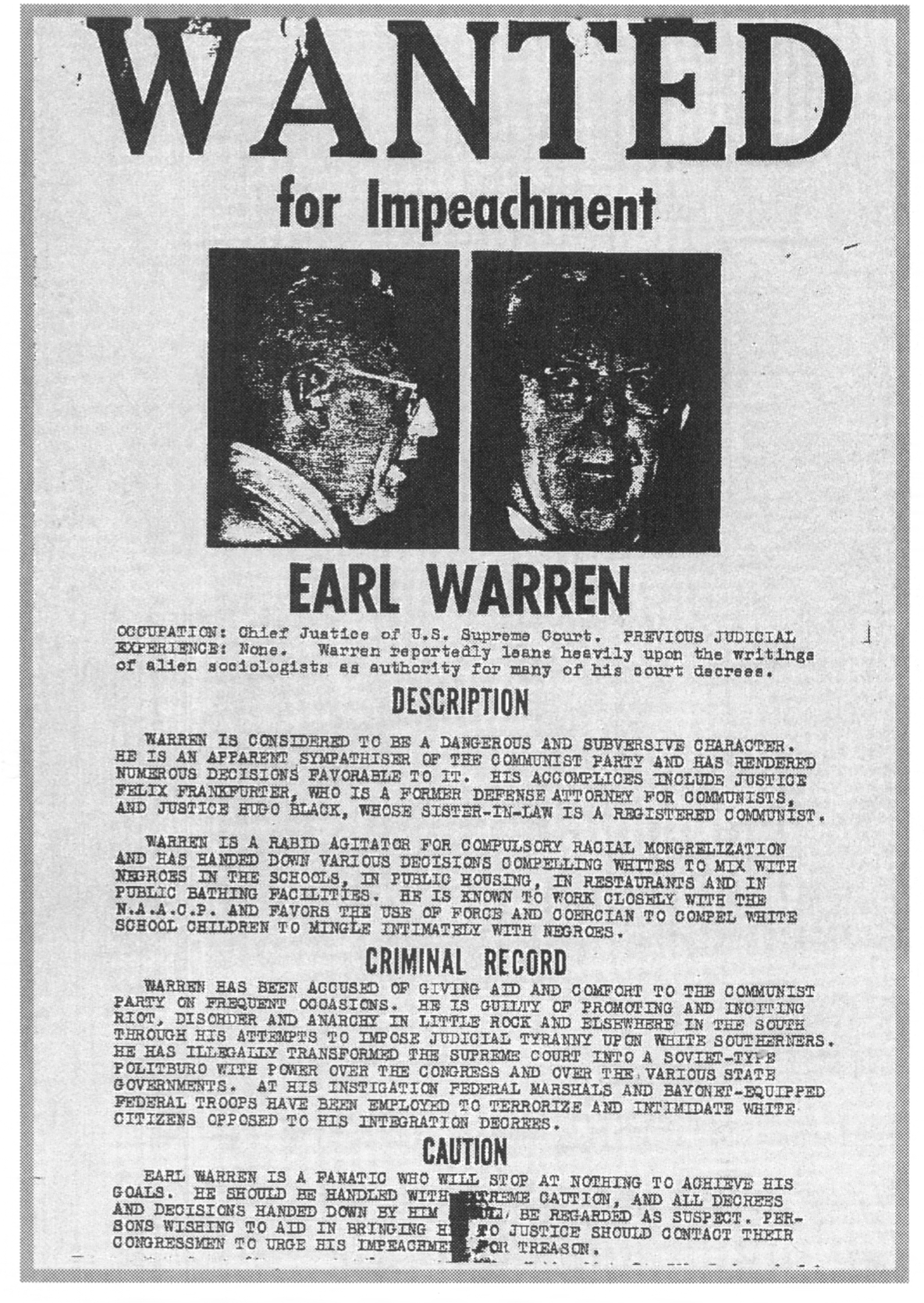
July 9, 1974 marked the end for a great man. On this day in 1974 the three time governor of California and probably the most important jurist of the 20th century Chief justice Earl Warren passed away. Back when Republicans were sane and President Eisenhower's politics were to the left of Barack Obama's it is claimed that Eisenhower once remarked that nominating Warren for the Chief Justice seat was "the biggest damned-fool mistake I ever made." In the in the 1946 running for governor of California he won the nominations of both the Democratic and Republican parties but the conservative's Wanted Poster from the 1960's was proof enough of Earl Warren's greatness.

July, 9 1986, your tax dollars at work as the fuckers investigate the fuckees. After spending a full year investigating, the Attorney General's Commission on Pornography releases their two-volume, 1960 page final report. This wasn't even the first time the government got their jollies studying porno. The Meese Report was an expansion of the 1970 Presidential Commission on Pornography.

A Sad Day For Music in 1995. Because of the death of Jerry Garcia the following month The Grateful Dead played their last concert, at Soldier Field in Chicago.

Ten Years Ago: Resulting from a demonstration in protest to the banning of the pro-reform newspaper Salâm, at least ten people died after Iranian police broke into the dormitories of Tehran University, slashing, busting, burning and throwing some students out of windows. On that same day a jury in Los Angeles ordered General Motors Corp. to pay $4.9 billion to six people severely burned when their Chevrolet Malibu exploded in flames in a rear-end collision. A judge later reduced the punitive damages to $1.09 billion. That still was not the end, GM settled the lawsuit for an undisclosed amount in July 2003. But don't fret General Motors fans, government will soon own 60 percent.

In 2001 Scientists discover why we are here. The only problem is that they can't figure out a way to explain it to us.

Five Years Ago: The final report of the US Senate Intelligence Committee states that the Central Intelligence Agency had provided unfounded assessments of the threat posed by Iraq that the Bush administration had relied on to justify going to war. Ya think?

Two Years Ago: David Vitter lost his moral high ground and said "I'm Sorry." after the brothelmister's name is found on a list associated with an escort agency operated by the so-called D.C. Madam. Jeanette Maier, the madam of a high-priced brothel that was shut down by federal authorities in 2002, came to his defense and called him “One of the nicest and most honorable men I’ve ever met.”

One Year Ago: When Sen. Edward M. Kennedy, battling a brain tumor, walked into the Senate to cast a dramatic vote in favor of long-stalled Medicare legislation, he received a well deserved thunderous applause. Senator Kennedy did not vote when the rest of them voted on H.R. 6304, giving one to the phone companies and screwing the people who elected them. It was business as usual. Our their Democratic controlled congress gave away OUR rights, privileges and liberties guaranteed by the Constitution that they took an oath to protect exactly 131 years after Alexander Graham Bell, Gardiner Greene Hubbard, Thomas Sanders and Thomas Watson formed the Bell Telephone Company.

And In Today's News an in depth report from the stately New York Times Do Women Like Men That Clean Shaven? But they left out the best line in the Gillette video that was explored.
Trees look taller when there's no underbrush.
Happy National Sugar Cookie Day.